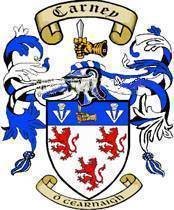
Carney & Wehofer Family
Genealogy Pages

Notes
Matches 12,601 to 12,650 of 13,676
| # | Notes | Linked to |
|---|---|---|
| 12601 | William is shown in the Gilbert family pedigree for the Visitation of Devon in 1564[1]as the son of Galfrid Gilbert of Compton and Joan Compton (daughter of William Compton of Compton), and with wife Elizabeth Champernon and son William Gilbert. On 6 July 1380, Elizabeth, widow of William Gilbert was granted administration of her husband's estate. | GILBERT, Sir William (I594778390)
|
| 12602 | William is shown in the Gilbert family pedigree for the Visitation of Devon in 1564[1]as the son of William Gilbert and Elizabeth Champernon, with wife Isabella Gambon and son Otho Gilbert. 23 Apr 1423: Yeovil: Inquisition post Mortem of Otes Chambernoun Esquire:[2] Otes died on 2 January last. William Bykebury , William Gilbert and William atte Wode are his kinsmen and next heirs, each aged 40 years and more, William Bykebury as son of Katherine daughter of Thomas son of Margaret one of the sisters of Richard father of Otes; William Gilbert as son of Elizabeth, second sister of the same Richard father of Otes; and William atte Wode as son of Joan, third sister of the same Richard father of Otes. 17 April 1431: Exeter: Inquisition post Mortem of Agnes widow of Otes Chambernoun:[3] Otes died without heir of his body. Agnes continued in her estate for life by right of a joint tenant in survivorship, and died so seised. She died on 29 January last. Elizabeth, Margaret, and Elizabeth, daughters of William Bykebyry and minors in the king's wardship, Otes Gilbert, and John atte Wode , are kin and next heirs of Otes Chambernoun . Elizabeth, Margaret, and Elizabeth are daughters of William son of Katherine daughter of Thomas son of Margaret, one of the sisters of Richard father of Otes Chambernoun . Elizabeth, first daughter, was aged 14 on 23 April last. Margaret was aged 7 years on the day following the feast of Saint... last. Elizabeth, third daughter, was aged 4 on ... Laurence last. Otes Gilbert is the son of Elizabeth, other sister of Richard father of Otes, and was aged ?13 on 24 March last. Owing to his minority, he is in the wardship of the abbot of Torre because William his father, of whom he is the heir, held a messuage and carucate in Blackawton of the abbot by service.... William Gilbert died three years before Agnes. | GILBERT, William (I594778391)
|
| 12603 | William la Zouche, Lord Zouche of Haryngworth, b. c 1342, d. 13 May 1396, MP 1382/3; m. (1) Agnes, probably daughter of Sir Henry Green, d. bet. 2 Dec 1391 and 28 Apr 1393; m. (2) Elizabeth, daughter of Edward, 1st Lord Despenser. She d. 10 or 11 Apr 1408. [Magna Charta Sureties] ------------------ William la Zouche, 3rd Lord (Baron) (la) Zouche (of Haryngworth); b. c 1342, m. 1st by 27 Oct 1351 Agnes (d. on or after 2 Dec 1391), (?)daughter of Sir Henry Green, Chief Justice of the King's Bench 1361-65, and had issue, including three younger sons (John, Edmund, Thomas); m. 2nd after 28 April 1393 Elizabeth (b. 10 or 11 April 1408), daughter of 1st Lord (Baron) le Despenser and widow of 2nd Lord (Baron) Arundel de jure (though he was never summoned to Parliament), and d. 13 May 1396, leaving another son Hugh and a daughter (Eleanor, m. 6th Lord (Baron) Lovel); his eldest son by his 1st wife [William 4th Baron la Zouche]. [Burke's Peerage] Note: Eleanor has to be daughter of 1st wife. See notes under her. Note: I am sure that they mean "d. 10 or 10 April 1408" for the 2nd wife Elizabeth. | LA ZOUCHE, William 3Rd Baron Of Haryngworth, Sir (I13176)
|
| 12604 | William Lewis came from England in the ship "Lion" and landed at Boston September 16th, 1632. He was admitted a freeman in November and joined the Braintree Company which in August, 1633 removed to Newtown, MA. In 1636, he came with a company to Hartford, CT and in 1659 again removed to Hadley, MA, which town he represented in the General Court in 1683. He was a trained military man, who evidentally took part in European wars. | LEWIS, Jr Capt. William Jr (I3943)
|
| 12605 | William Logston came to America from England around age 13, as an indentured servant to Lord Baltimore. He was later able to purchase land and he and Honora became wealthy landowners. William Logston was sold as an indentured servant, the British were known for rounding up many who crossed their path and shipped to America as workers. William may have been sold by his own family....but he also may have been captured against his will. | LOGSDON, William S. (I594768174)
|
| 12606 | William Mackintosh, 15th of Mackintosh was the son of Lachlan Mackintosh, 14th of Mackintosh and Jean Gordon. He married Margaret Ogilvie. He died on 23 August 1550. He held the office of Deputy Lieutenant (D.L.) of Inverness-shire.1 He held the position of 15th Chief of Clan Mackintosh. He held the position of 16th Chief of Clan Chattan in 1524 ______________________ William Mackintosh, 15th of Mackintosh (died 1550) was the chief of the Clan Mackintosh, a Scottish clan of the Scottish Highlands. He was also chief of the confederation of clans that was known as the Clan Chattan. William Mackintosh, 15th of Mackintosh was the son of Lachlan Beg Mackintosh, 14th of Mackintosh and his wife Jean Gordon, daughter of Sir Alexander Gordon of Lochinver. His father, Lachlan Beg Mackintosh, had been murdered in 1524 when William was just three years old. Therefore, Hector Mackintosh, natural son of Ferquhard Mackintosh, 12th chief was chosen as his tutor and temporary leader of the clan. Hector's leadership was not universally acknowledged by the clan and as a result the Earl of Moray who was also a relation of William had him and his mother removed to his own house. He also arranged for William's mother to re-marry. The newly elected leader of the Clan Mackintosh and Clan Chattan, Hector, with the support of the clan saw the Earl's actions as an insult to themselves to use their young chief for his own designs. The removal of their chief was resented so much that the clan invaded the Earl of Moray's lands and during the year 1527 the Earl's tenants were in a perpetual state of alarm constantly having their crops in flames and their cattle lifted. Subsequently, a royal mandate was issued on 9 November 1528 for the extermination of the invading Clan Chattan, during the reign of James V of Scotland. It was addressed to the sheriffs of Kincardine, Aberdeen, Banff, Elgin, Forres, Nairn and Inverness and to the Earl of Moray himself, who was lieutenant general of the north. It was also issued to the Earls of Sutherland and Caithness, John Lord Forbes, Hugh Fraser, 3rd Lord Lovat, John Grant of Freuchy, Ewen the Captain of Clan Cameron and John Mackenzie, 9th of Kintail, all to attack and kill the Clan Chattan. According to 19th historian Alexander Mackintosh-Shaw, if this mandate had been acted upon by all of the persons to whom it was addressed, then the history of the Clan Chattan would have probably been ended. However, owing to the friendly efforts of chiefs in the north and the unwillingness of the Earl of Moray to take such extremities, it was not. It did however stop the Clan Chattan from invading the Earl of Moray's lands. The leader of the clan, Hector Mackintosh, is not mentioned in these disturbances which seem to have been carried out by the clansmen. Two years later the Earl of Moray marched into Mackintosh country and took 300 prisoners, many of whom were executed including Hector's brother, also called William. Hector escaped and remained for some time in hiding. Upon the advice of Dunbar, Dean of Moray, Hector surrendered himself to the king who forgave him for past offences and placed him in royal favour and this may have been because at the time the king was dissatisfied with the Earl of Moray. William Mackintosh, 15th of Mackintosh married Margaret, daughter of Alexander Ogilvie, 1st Baron Findlater. Their children were: 1. Margaret Mackintosh, who was married successively to the lairds of Grant, Abergeldie, Pitsligo and William Sutherland, 9th of Duffus. 2. William Mackintosh, who died young. 3. Lachlan Mor Mackintosh, 16th of Mackintosh, heir and successor as chief of the Clan Mackintosh and Clan Chattan. The misfortunes of the tutor Hector's quarrel with the Earl of Moray that had been brought upon the clan appear to have been of a temporary nature and William Mackintosh, 15th chief took up his position as head of the clan in about 1540, aged nineteen. In 1544, the Clan Chattan became involved in the dispute over the chiefship of the Clan Macdonald of Clanranald. The son of the previous chief of Clan Ranald was John of Moidart who was challenged by his relative, Ranald, who was married to a daughter of Hugh Fraser, 3rd Lord Lovat who in turn gave Ranald his support. George Gordon, 4th Earl of Huntly was the king's lieutenant in the north and also supported Ranald and Fraser of Lovat, who together with the Clan Grant and Clan Chattan marched against John of Moidart. On this occasion William Mackintosh, chief of Clan Mackintosh and Clan Chattan, was followed by 1500 men. The Gordons, Grants, Mackintoshes and Clan Chattan separated from Lord Lovat's force. Lovat and his clan were defeated by John of Moidart in the subsequent Battle of the Shirts in which it is said that only eight MacDonalds and four or five Frasers survived, with John of Moidart succeeding in his claim to the chiefship of Clan Macdonald of Clanranald. In 1547-48, the Earldom of Moray was conferred upon the Earl of Huntly. William Mackintosh, 15th of Mackintosh was inclined to support the doctrine of the Reformation which Huntly was a staunch opponent to. According to 19th century historian Alexander Mackintosh-Shaw, chief William Mackintosh commanded a following more numerous than Huntly could raise from his own estate and Huntly deprived Mackintosh of his office of deputy lieutenant. He goes onto say that Lachlan Mackintosh who was the son of the man who had murdered William's father, Lachlan Beg Mackintosh, 14th chief, had been sowing the seeds of discontent among the Clan Macpherson who were part of the Clan Chattan and that he was no well-wisher of William. Huntly, at the same time of withdrawing William's office from him gave lands to the conspiring Lachlan who then accused William of conspiring to take the life of Huntly. Huntly then seized chief William Mackintosh and put him on trial on 2 August 1550 at Aberdeen. Thomas Menzies, the Provost of Aberdeen defended William Mackintosh with some success. However, on 23 August 1550, William Mackintosh suffered death by the axe. There are other accounts, including that by William Forbes Skene, that state that William Mackintosh had burned Huntly's Auchindoun Castle which is why Huntly had him executed, but Alexander Mackintosh-Shaw states that this story is entirely fictitious. Huntly had made the traitor, Lachlan, Sheriff-depute of Inverness, jointly with Munro of Foulis. However, Lachlan the traitor was killed one year later in his house by some indignant clansmen. Parliament later held an inquiry into Huntly's actions and found that his execution of William Mackintosh was illegal and he had to compensate the Mackintosh family. In 1554, Huntly, along with the Earl of Argyll were ordered to exterminate the Clan Macdonald of Clanranald, but both failed in their objectives; Huntly, because the Highlanders were so much exasperated against him for having executed William Mackintosh in 1550, that he declined to face Clan Ranald with such an army, disbanding his forces. | MACINTOSH, William 15th of Mackintosh, 16th of Clan Chattan (I594777402)
|
| 12607 | William married Ann Wilds, widow of Thomas Wilds, in 1665 in Isle of Wight County. Later after William died, the administer of W illiam's estate was Alexander Murray, who married Ann King Wilds Collins. Ann stated that her two young daughters were to live with their uncle Robert King when she died. Source: World Family Tree Vol. 11, Tree 0778. Ann's maiden name may have been Thurston (Thruston). | THRUSTON, Ann (Wilde) (King) (I24339)
|
| 12608 | William Montagu, alias de Montacute, 1st Earl of Salisbury, 3rd Baron Montagu, King of Mann (1301 – 30 January 1344) was an English nobleman and loyal servant of King Edward III. The son of William Montagu, 2nd Baron Montagu, he entered the royal household at an early age and became a close companion of the young Prince Edward. The relationship continued after Edward was crowned king following the deposition of Edward II in 1327. In 1330, Montagu was one of Edward's main accomplices in the coup against Roger Mortimer, who until then had been acting as the king's protector. In the following years Montagu served the king in various capacities, primarily in the Scottish Wars. He was richly rewarded, and among other things received the lordship of the Isle of Man. In 1337, he was created Earl of Salisbury, and given an annual income of 1000 marks to go with the title. He served on the Continent in the early years of the Hundred Years' War, but in 1340 he was captured by the French, and in return for his freedom had to promise never to fight in France again. Salisbury died of wounds suffered at a tournament early in 1344. ... Salisbury died on 30 January 1344. He was buried at Bisham Priory in Berkshire, adjoining his home, Bisham Manor. He had founded the priory himself in 1337, on his elevation to the earldom.[31] King Edward's financial obligations were never paid in full during the earl's lifetime, and at Salisbury' death the king owed him £11,720. Of this, some £6374 were written off by his executors in 1346. Family In or before 1327 Salisbury married Catherine, daughter of William de Grandison, 1st Baron Grandison. Two anecdotal stories revolve around Catherine Montagu; in one she is identified as the "Countess of Salisbury" from whose dropped garter Edward III named the Order of the Garter. In the other, Edward III falls in love with the countess, and arranges to be alone with her so he can rape her. Neither story is supported by contemporary evidence, and the latter almost certainly is a product of French propaganda. William and Catherine had six children, most of whom made highly fortunate matches with other members of the nobility. The first Earl of Salisbury made enormous additions to the family fortune; at the time of his father's death, the lands had been valued at just over £300. In 1344, only the annual income of the lands has been estimated to more than £2,300, equivalent to about £2 million in present-day terms. Edward was also free with granting franchises to Salisbury, including the return of writs, which gave the earl authority in his lands normally held by the royally appointed sheriff. Salisbury's oldest son William succeeded his father in July 1349, while still a minor, as William Montagu, 2nd Earl of Salisbury. The younger William was one of the founding members of the Order of the Garter, but he never enjoyed the same favour with the king as his father had. The children of William and Catherine were as follows: 1. Elizabeth Montagu, died 1359, married first, Hugh le Despencer, Baron le Despencer (1338) before 27 April 1341, married second Guy de Brian, 4th Baron Brian, after 1349. 2. William Montacute, 2nd Earl of Salisbury, born 1328, died 1397, succeeded his father 11 June 1349. 3. John de Montacute, 1st Baron Montacute, born 1330, died 1390, father of John Montacute, 3rd Earl of Salisbury. 4. Philippa Montagu, born 1332, died 1381, married Roger Mortimer, 2nd Earl of March. 5. Sibyl Montagu, married Edmund FitzAlan, the disinherited son of Richard FitzAlan, 10th Earl of Arundel. 6. Agnes Montagu, contracted to marry John, eldest son of Roger Grey, 1st Baron Grey de Ruthyn. 7. Alice Montagu, married Ralph Daubeney, son of Helias Daubeney, 1st Baron Daubeney. (This may be an error see William Montagu, 2nd Baron Montagu) https://en.wikipedia.org/wiki/William_Montagu,_1st_Earl_of_Salisbury geni.com Sir William Montagu, 1st Earl of Salisbury Also Known As: "1st Earl of Salisbury", "3rd Baron Montacute", "Knight of the Bath", "Knight Banneret" Birthdate: circa 1301 Birthplace: Cassington, Oxfordshire, England Death: January 30, 1344 (38-47) Windsor Castle, Berkshire, England (Wounds from a tournament at Windsor.) Place of Burial: Bisham, Berkshire, England, UK Immediate Family: Son of William Montagu, 2nd Baron Montagu and Elizabeth de Montfort Husband of Catherine de Montagu, Countess of Salisbury Father of Elizabeth de Brienne; William de Montacute, 2nd Earl of Salisbury; John de Montacute, 1st Baron Montacute; Anneys de Grey; Sibyl de Montague; Robert Montagu; Philippa de Mortimer, Countess of March and Edward Montagu < less Brother of Alice Daubeney; John Montagu; Hawise Bavent; Mary Cogan; Edward Montagu, 1st Baron Montagu; Simon Montacute, Bishop of Ely; Isabel Montagu, Abbess of Barking; Maud Montagu, Abbess of Barking and Elizabeth Montagu, Prioress of Halliwell < less Occupation: King of the Isle of Man, 1st Earl of Salisbury, 1st Earl of Solisbury and 3rd Baron Montagu | MONTAGU (MONTACUTE), William De II (I8591)
|
| 12609 | William Mor Mackintosh, 2nd of Killachie, had two sons, John and Donald, who both appear in a band to Sir John Campbell of Cawdor dated 28 August 1534 and also in the 1543 band of the Clan Chattan. John supported Matthew Stewart, 4th Earl of Lennox against the Regent Arran and was with him at the Battle of Glasgow Muir in 1544. He died before his father who was therefore succeeded by his second son, Donald --- The Mackintoshes of Killachie were a minor noble Scottish family and the senior cadet branch of the Clan Mackintosh, a Scottish clan of the Scottish Highlands. Their most famous member was James Mackintosh who was a Scottish jurist, Whig politician and historian. Alan Mackintosh, 1st of Killachie was the third son of Malcolm Beg Mackintosh, 10th chief of Clan Mackintosh. He was succeeded by his eldest son, William. William Mor Mackintosh, 2nd of Killachie, had two sons, John and Donald, who both appear in a band to Sir John Campbell of Cawdor dated 28 August 1534 and also in the 1543 band of the Clan Chattan. John supported Matthew Stewart, 4th Earl of Lennox against the Regent Arran and was with him at the Battle of Glasgow Muir in 1544. He died before his father who was therefore succeeded by his second son, Donald. Donald Mackintosh, 3rd of Killachie was tutor during the minority of Lachlan Mor Mackintosh, 16th of Mackintosh. He had one son, Angus, by Catherine, daughter of Hugh Rose, 9th of Kilravock Castle who succeeded him. __________________________________ | MACKINTOSH, William - Mór 2nd of Kyllachy-Killachie (I594771908)
|
| 12610 | William moved to Bedford from Great Barford in 1607 and on 06 Sep 1608, he married Margaret Smith of Milton, Bucks. He was a maltster, as well as being a warden of Bedford's High Bridge. William became a Churchwarden at St. Paul's in 1610. He was interred on 05 April 1633 in the South Chancel, west end, under the south wall. His wife survived him and is buried at St. Michael le Querne, London. | FITZHUGH, Hon William Beverley (I594770328)
|
| 12611 | William of Wokingham (his recorded residence) and his brother Edward were heirs of Robert of Barkham. William received Robert's personal estate. [SOURCE: Larry Chesebro'] Please verify / prove information and notify contributor of corrections / errors. Information amassed from various sources - family records, official publications & documents, gedcom files from relatives, etc. | BALL, William (I2605)
|
| 12612 | William Pendergrass (1730-1804) & Martha Patti Titus Atwater (1734-d/c ) William Pndergrass (Robert,John, Michael,John) was born 1730 in Orange co., North Carolina and died 1804 same state. Martha was born 1734 in orange co., North Carolina and died same place. She married William Pendergrass 1748 and to this union was born 10 children. James Pendergrass was born about 1640 in Ireland and immigrated to Virginia about 1668/69. He died in 1718 in Virginia. James married Mary ??? who was born about 1640 in Ireland, she died 15 Sep 1715 in Virginia. (James' father might have been Phillip Pendergrass, he was the correct age and the only other of that surname in the area.) James and Mary's son Michael Pendergrass was born about 1664 in Ireland and married Rebecca Bolling in 1684 in Northumberland County, Virginia. Michael and Rebecca's son, John Pendergrass was born about 1685 in Northumberland County, Virginia, he died there on 20 Jul 1715. John married Anne Plesants in 1705. John and Anne's son Robert Pendergrass was born 8 Dec 1711 in Northumberland County, Virginia, he died in 1782 in Orange County, North Carolina. Robert married Elizabeth Manley, their son William Pendergrass was born 1730 (VA or NC), he died 1804 in Orange County, North Carolina. William married Martha Patti Titus in 1748. William and Martha's son David Pendergrass was born about 1751 in Orange County, North Carolina, he died 2 Nov 1804 in Chester District, South Carolina. He married in November 1777 in Hillsborough County | PENDERGRASS, William (I594771446)
|
| 12613 | William Rankin and Mary Huston had several children including David Rankin m. Anne Campbell who relocated to Greene co., TN. One of his children Robert Rankin (1773-1837) m. 1798 Elizabeth "Betsy" Dinwiddie (b. 1775). She was of VA, daughter of James Dinwiddie. Betsy died in Greene Co., TN Robert died 1837 Mt. Bethel Pres. Church Cemetery, Greene Co., TN. Children: Anne Dinwiddie Rankin born Greene Co., VA m. William Sam West, but shown married to a Sevier in another record, son of Valentine Sevier and brother of Gov. John Sevier, and lived in Sevier Co., TN for some time. Thomas C. Rankin born Greene Co., TN m.; other married Elvirah "Mary" Blackburn. James Dinwiddie Rankin born Greene Co., TN m. Margaret Branner born Jefferson Co. TN Mary "Polly" Rankin; not married Robert's brother David Rankin Jr. (1775-1836) m. 1802 Jane Belle "Jennie" Dinwiddie (1784-1853). Buried Mt. Bethel Pres. CH Cem. Greene Co., TN. Children: Lewis Rankin m. Nancy Mary Gray Wm Dinwiddie Rankin m. Elizabeth Lightfoot Roadman Isabella Rankin m. Edward H. West, III James W. Rankin m. Nancy Earnest Mary Ann Rankin m. Hugh Cain, Jr. John Rankin m. Louisa A. Gray; 2nd Elizabeth Range Robert L. S. Rankin m. Louisa A. DeVault Elizabeth Jane Rankin m. Isaac S. Bonham, Rev. Nancy D. Rankin m. Thomas W. Earnest, 2nd Thomas Washington Fain Malinda Rankin m. Lewis S. Earnest David Rankin, III Adaline Rankin m. Archibald G. Register, Rev. | DINWIDDIE, Elizabeth "Betsy" (I6781)
|
| 12614 | William Speight was born est 1778, in NC. His first born was Albert, born in Wake County in 1800. William then moved to Dickson County TN where the remaing three of his sons were born. (Jesse, William, Arthur). Two fellow researchers have said his wife's name is Mary Berton (or Benton), or Sally Bish. I have found a William & Sally Bish, but cannot prove them this is the only marriage or relative of mine. I have found little info on Mary Berton (or Benton). WILLIAM SPEIGHT settled in Dickson County from Wake County NC around 1800 or a little after. An old biography written by Tom Speight's great uncle said William settled on the "Westside of the Harpeth River around 1800". He had a son, Albert S. born around 1800. His other sons: Jesse M. b. 1805 Dickson, John T. (Alsey) b.abt 1807 Dickson, William D. b. 2-15-1811 | SPEIGHT, William (I14000)
|
| 12615 | William T. Anderson[a] (c. 1840 – October 26, 1864), known by the nickname "Bloody Bill" Anderson, was a soldier who was one of the deadliest and most notorious Confederate guerrilla leaders in the American Civil War. Anderson led a band of volunteer partisan raiders who targeted Union loyalists and federal soldiers in the states of Missouri and Kansas. Raised by a family of Southerners in Kansas, Anderson began to support himself by stealing and selling horses in 1862. After a former friend and secessionist turned Union loyalist judge killed his father, Anderson killed the judge and fled to Missouri.[1] There he robbed travelers and killed several Union soldiers. In early 1863 he joined Quantrill's Raiders, a group of Confederate guerrillas which operated along the Kansas– Missouri border. He became a skilled bushwhacker, earning the trust of the group's leaders, William Quantrill and George M. Todd. Anderson's bushwhacking marked him as a dangerous man and eventually led the Union to imprison his sisters. After a building collapse in the makeshift jail in Kansas City, Missouri killed one sister, and left another permanently maimed, Anderson devoted himself to revenge. He took a leading role in the Lawrence Massacre and later took part in the Battle of Baxter Springs, both in 1863. In late 1863, while Quantrill's Raiders spent the winter in Sherman, Texas, animosity developed between Anderson and Quantrill. Anderson, perhaps falsely, implicated Quantrill in a murder, leading to the latter's arrest by Confederate authorities. Anderson subsequently returned to Missouri as the leader of his own group of raiders and became the most feared guerrilla in the state, robbing and killing a large number of Union soldiers and civilian sympathizers. Although Union supporters viewed him as incorrigibly evil, Confederate supporters in Missouri saw his actions as justifiable. In September 1864, Anderson led a raid on the town of Centralia, Missouri. Unexpectedly, his men were able to capture a passenger train, the first time Confederate guerrillas had done so. In what became known as the Centralia Massacre, Anderson's bushwhackers killed 24 unarmed Union soldiers on the train and set an ambush later that day which killed over a hundred Union soldiers. Anderson himself was killed a month later in battle. Historians have made disparate appraisals of Anderson; some see him as a sadistic, psychopathic killer, while others put his actions into the perspective of the general desperation and lawlessness of the time and the brutalization effect of war. Death: Union military leaders assigned Lieutenant Colonel Samuel P. Cox to kill Anderson, providing him with a group of experienced soldiers. Soon after Anderson left Glasgow, a local woman saw him and told Cox of his presence.[141] On October 26, 1864, he pursued Anderson's group with 150 men and engaged them in a battle called the Skirmish at Albany, Missouri.[142] Anderson and his men charged the Union forces, killing five or six of them, but turned back under heavy fire.[143] Only Anderson and one other man, the son of a Confederate general, continued to charge after the others had retreated. Anderson was hit by a bullet behind an ear, likely killing him instantly.[144] Four other guerrillas were killed in the attack.[143] The victory made a hero of Cox and led to his promotion. | ANDERSON, Lt. William "Bloody Bill" Tompson (I594784552)
|
| 12616 | William Thrall is the founder of the Thrall family in the United States. He was born in 1605 in Sandridge, Hertfordshire, England and came to the Colonies on the "Mary and John" in the year 1630. The "Mary and John" was a vessel of four hundred tons captained by a man named Squeb and the vessel sailed with 180 passengers. William was part of a company of Puritans under the leadership of Rev. John Wareham of Exeter and Rev. John Meverick, both ministers of the Church of England Setting sail from Plymouth, England on 20 March, they first came ashore on 30 May 1630. They disembarked with what goods they had, to some high land in the salt meadow, now a part of the city of Boston. They named the place Dorchester, which was selected by the captain of the "Mary and John" as he came from Dorchester, England. Page 277 of Prince's Chronology of New England records "May 30, Lord's Day. Mr. Wareham and his church, and their goods, were put ashore at Nantasket Point. The went immediately to Charlestown, and from thence to Mattepan, and began a town and named it Dorchester, and the native Indians were kind to them." Revs. Wareham and Meverick and their group stayed in Dorchester less than five years, as a number of their menfolk had discovered more fertile land below the first falls of the Connecticut River, at the junction of the Farmington River just above Hartford. Part of the Colony went by boat and the remainder traveled across the one hundred miles of virgin forest, to establish the town of Windsor. Windsor was unofficially known as Thrallville in the early years. The first we know of William Thrall is that he is listed with the following men who were among the thirty men who went from Windsor to join in the fight against the Pequod Indians in May 1637. Capt. John Mason, Sgt. Benedict Alvord, Thomas Barber, Thomas Buckland, George Chappel, John Dyer, James Eggleston, Nathaniel Gillet, Thomas Gridley, Thomas Styles, Sgt. Thomas Stares, Richard Osborn, Thomas Parsons, William Thrall. The Indian village in this case was so completely destroyed that for many years, the settlers had no further trouble with the Indians. Some years later, the participants were given land grants. To quote from Dr. Styles records with regard to the first Indian war in New England, "The danger was imminent, and so complete the victory that it caused universal rejoicing throughout New England, and a grant of land was given each soldier and officer, and to this day the memory of an ancestor who was in the Pequod fight, is an honorable heirloom in every Connecticut family". William Thrall is mentioned many times in the early records. His lot shows up in the first plot of Windsor, between the lots of Nicholas Palmer and Thomas Bascomb, and ran from the road to the Farmington River. In 1646, William sold this lot to Nicholas Palmer and moved to Simon Hoyte's place, north of the village. Robert Wilson bought a half interest with William in the Hoyte's 80 acres, but sold his half to Thrall in 1654. This 80 acres has been part of the holdings of the Thrall family ever since, thanks to William Thrall's will We know very little about the wife of William Thrall. She is referred to in the Old Windsor records as Goode Thrall, but "Goode" was an expression applied to women with families and it is simply an abbreviation of "Goodwife". Whether she came over to New England on the "Mary and John" with her husband or they met in Dorchester, has never been established The record of her death simply states, "Goode Thrall, wife of William, died 30 July 1676". | THRALL, William (I6320)
|
| 12617 | WILLIAM UNDERWOOD (1720-1773) and ELEANOR (ELLEN) HACKLEY. William was a lawyer and apparently the 5th WILLIAM in a direct line of WILLIAM UNDERWOODs who---going backwards in time---lived in Fauquier Co., Prince William Co., King George Co., Westmoreland Co., Richmond Co., and Lancaster Co. in Virginia's "Northern Neck" between the Rappahannock and Potomac Rivers. This William left a will naming only a daughter Jaely Underwood, but it is believed he bestowed legacies upon other children before he made his will; among whom was believed to be son John Underwood and son Annet Underwood. WILLIAM UNDERWOOD V, Esq., was the son of: WILLIAM UNDERWOOD IV and JAEL SHIPPE (related to Pres. Harry S. Truman and William Barrett Travis of the Alamo, and also to the Hackley family just mentioned). William IV was the son of: WILLIAM UNDERWOOD III and JOAN UNDERWOOD---she was apparently an Underwood, but unrelated to our main line [one researcher suggested her maiden name may have been HURLEY]. "Major William Underwood" is sometimes found in records. William III was the son of: WILLIAM UNDERWOOD II ("Colonel") and MARY MOSELEY. Col. William II was the son of: WILLIAM UNDERWOOD I ("Captain") and MARGARET DEW / DEWE. William was a tobacco merchant and planter, but Margaret's identity regarding her origins and surname has been elusive until recently. There has long been the idea that this Margaret was a ROBERTS or a MASON. This is mainly due to the fact that a marriage record exists for the marriage to Margaret ROBERTS, pairing a couple in the right period with the right first names. The MASON marriage was proffered as an alternate possibility, due to the fact that later UNDERWOOD family documents and even business entanglements include at least one member of the MASON family (one Josiah MASON) in such as way as to imply a familial relationship; hence, an assumption that that this could be the point of connection. (It has later been seen that the Josiah MASON in question was an in-law, rather than a true cousin.) When more data is uncovered in England, we see more clearly that the DEWE family documents and wills from that period indicate that both Margaret and her sister Elizabeth married UNDERWOOD men, and that Margaret's husband was William, and that they and their young family moved from London to Isle of Wight County Virginia, via Bermuda, in the 1630's---in fact probably before 1632. The family connections of neighbors, friends and other associates and relatives all fit this scenario in London, Hertfordshire, Kent, and Isle of Wight County Virginia, as does later connections in Virginia's Northern Neck. Margaret's DEW / DEWE family connections include her in-laws the BENNETT family, the same as that of one of the Colonial Governors of Virginia. Captain WILLIAM and MARGARET UNDERWOOD were the parents of at least 1 son and upwards of 5 daughters. This ordinary couple were the direct ancestors of U.S. Presidents JAMES MADISON and THEODORE ROOSEVELT, First Lady ELEANOR ROOSEVELT, General GEORGE SMITH PATTON, JR., and General-of-the-Army GEORGE CATLETT MARSHALL. Prior to our line settling in eastern Culpeper County and southern Fauquier County in the early-to-mid 1700's, the main family properties were: 1) "Claymont": Held by the family since its patent by WILLIAM UNDERWOOD II in 1658, it was about 10,000 acres in its original total, being held until about 1720. The old manor house is gone, but its location can be traced by satellite image. Claymont is in modern Westmoreland Co., at its far N/W border with King George Co., where is now the Ingleside Winery and the Rappahannock River Valley National Wildlife Refuge. The old house site is just about 5 miles due West of GEORGE WASHINGTON's birthplace and 3 miles S/W of JAMES MONROE's birthplace. 2) Land in Richmond County is the first land that WILLIAM UNDERWOOD II patented on Virginia's Northern Neck in about 1650. Between Richmond County Courthouse at Warsaw and the Tappahannock Bridge which crosses over to Essex County, there is a magnificent 1730's plantation house called "Sabine Hall" built by Landon CARTER at the edge of UNDERWOOD's original land. 3) Land in Isle of Wight Co., VA, on the James River, was acquired by WILLIAM UNDERWOOD I and settled in the 1630's. The 1st WILLIAM UNDERWOOD in America---our immigrant ancestor---has been difficult to distinguish from other William UNDERWOODs in the same time period in England and Virginia. It would seem, however, from Wills and Probates in England, and from genealogies on file in the College of Arms in London and other public records, that our WILLIAM UNDERWOOD I was apparently the 2nd son of: EDMUND UNDERWOOD (Sr.) (1576-1631) and ROSE FAIRCLOUGH (1580-1656). Edmund was a Grocer in London and in full business partnership with his younger brother ROBERT UNDERWOOD (1580-1638) who married Rose's younger sister DOROTHY FAIRCLOUGH (1584-1531). They owned "The Woolsack" in Bucklersbury [a lane in the geographic center of the old City of London], which was a grocery, apothecary, warehouse, and dual dwelling house which consisted of two huge houses that adjoined, with business and warehousing on the street level, more warehousing in the multiple cellar levels below, and several stories high of dwelling space in the upper floors. Both Underwood brothers had huge families, as was common, and technically each family had their own house. On the business side, the apothecary area also served as a sort of small medicinal clinic, and temporary overnight boarders with medical needs were apparently common in the Underwood houses. ROSE & DOROTHY FAIRCLOUGH were the daughters of JOHN FAIRCLOUGH and ANNE SPENCER of the very famous SPENCER family (ancestors of Winston CHURCHILL, Princess Diana, and several famous Americans). The FAIRCLOUGH family (also seen as FAIRCLOTH, and countless other odd spellings) had a manor house at Fairclough Hall a mile or so S/E of Weston, Hertfordshire, and also had a 2nd home in Goldington, just across the county line into Bedfordshire. They originally came from Lancashire sometime before c.1430. EDMUND & ROBERT were born at their ancestral home in Weston, Hertfordshire, about 40 miles North of London, where, according to a 1634 pedigree, the family had resided since about the early 1300's. They were sons of: GEORGE UNDERWOOD (Sr.) (1541-1597) and ALICE PAPWORTH (c.1543-after 1600; dau. of William PAPWORTH of Hitchin). George was the son of WILLIAM UNDERWOOD, Constable of Weston (c.1502-1560) and JOHANNA CLARKE (c.1515-aft.1572; dau. of John CLARKE of Stevenage, and sister of the earlier Sir Edward CLARKE of Berkshire). William was the son of: THOMAS UNDERWOOD (c.1475-1561) and ISABELLA _______. Thomas and his son William and HIS son George all had many children, including many sons with the same names from one generation to the next. Lots of these men found work in London and nearby areas, and leads to the tangle of duplicate names among 1st- and 2nd-cousins who very obviously are related to one another, but often it is difficult to say from which father and grandfather they descend. Other contemporary documents exist, but are expensive to have researched, as it must be done by a herald of the College of Arms or some wealthy and hopefully knowledgeable family member who could travel to London and Hertfordshire to do the research in person. Thomas was apparently the son of: WILLIAM UNDERWOOD, JR. (c.1445-c.1500) and ALICE ______. William Jr. was the son of: WILLIAM UNDERWOOD, SR. (c.1420-_____) and JOAN _______. William Sr. was the son of: JOHN UNDERWOOD (c.1396-_____), who was the son of: WILLIAM UNDERWOOD (Sr.) (c.1360-aft.1428), beyond which it is difficult to tell from the local land records. These manorial court records (of Weston Manor, compiled by the PRYOR family a century ago and donated to the Hertford County records office) helped with these earliest 4 generations of UNDERWOOD names and dates. The actual extended pedigrees apparently exist in the College of Arms in London, which would take this line back at least 2 more generations and maybe more. It is supposed that most of the older Underwood families in the Counties of Norfolk, Suffolk, Essex, Kent, Surrey, Berkshire, Buckinghamshire, Dorsetshire, Devonshire, Shropshire, and so forth, are all descended from the main trunk of the family which would probably prove to be centered around Leicestershire in the 1200's and Nottinghamshire from the 1100's on back. An Underwood family in Roxburghshire on the Scottish border appears to also have origins in the early 1600's much further to the south, possibly even to our London family. The families in Weston Hertfordshire, and those in Bedfordshire and possibly Warwickshire and Buckinghamshire are believed to all be linked from the late 1200's and early 1300's onward. There is a branch in Dorchester Dorsetshire which seems to be fairly closely connected to our Hertfordshire and London family. Our London family also owned property in Shorne and Greenwich parishes in County Kent (London's S/E suburbs and connected routes to the S/E); as well as property in the South Riding portion of County York in northern England. There is also a branch in Cambridgeshire/Huntingdonshire and another in Northamptonshire which seem to be part of the Hertfordshire branch. The UNDERWOOD family in Bermuda in the Atlantic Ocean is proven to be of our London family origin, and actually may account for some of the seemingly unconnected UNDERWOODS (at least one Thomas U. for example) that show up in Virginia in the latter 1600's and early 1700's. Lastly, it is proved that during the 1640's and 1650's, our UNDERWOOD family in London purchased land in County Tipperary in Ireland, and there may have been some family members actually move there and settle. The UNDERWOODS that settled in Maryland, Delaware and Pennsylvania seem to mostly come from our London family. The New England branches of the family have multiple origins | UNDERWOOD, William (I594767895)
|
| 12618 | William was born in 1800 in North Carolina. Pioneers of Morgan Co Indiana. They had been married 66 years and have been apart only three consecutive days and two nights since their marriage. There were born to them 26 children (single births), 13 girls and 13 boys. Seven of these lived to adult age; the others all died in infancy. Only 3 of the 26 are living (at time of writing), 2 sons and one daughter. Three sons went into the army. One was captured near Vicksburg and died in a Rebel prison. One died in the Union Hospital at Nashville. The other one came home and died of consumption not long afterward. The old father and mother are quite sad when speaking of the deaths of their sons, particularly of the one who was made a prisoner, for, like Benjamin, he was the youngest? William married Delilah Ray. Their known children are Joseph 1826-1880, Moses 1829-1891, William H 1830-1916, Mitchell 1839-1865, Thomas 1841-1865 Rebecca 1843-1928 and Benjamin the youngest born around 1845. William's wife's name was Delilah Ray, born in Crab Orchard, Kentucky the first of November, 1800. Mr. Parker came to Indiana in 1819, stopping near Madison for a short time. Delilah and William married on Christmas day, 1823. William was tall and slender. A tough, wiry man, with the powers of endurance to sustain him at hard work from dawn to dark. He was a great axman, and cleared year after year acres of land in the White River bottoms. He was of light complexion and singuine temperament. He and his wife were members of the Christian church since 1845 according to "The Pioneers of Morgan County," by Noah J. Major and Logan Esarey, Indiana Historical Society Publications, Volume V Number 5, Copyright 1915. William died in 1894 and is buried at Williams Cemetery in Morgan County, Indiana. | PARKER, William (I594779610)
|
| 12619 | William was born in 1822. He passed away after 1880. Census Title: 1850 Greene Co., Missouri Type: Census Title: 1850 Wright Co., Missouri Type: Census Title: 1860 Webster Co., Missouri Type: Census Title: 1870 Webster Co., Missouri Type: Census Title: 1880 Greene Co., Missouri last census in Green, Hickory, MO, living with Margaret age 18 and Minerva age 14, daughters. Supporting information from Glenn Kennedy Supporting information from Relative of Burthena Holdaway Married Carroll William Holdaway Would list Name of Holloeay lots of other supporting information. | HOLDAWAY, William Carrol (I4787)
|
| 12620 | William was born in 1917. William Swafford ... He passed away in 1998. Sources 1920 "United States Census, 1920," database with images, FamilySearch (https://familysearch.org/ark:/61903/1:1:MNGY-35R : accessed 14 December 2016), William Swafford in household of L A Swafford, Civil District 4, Bradley, Tennessee, United States; citing enumeration district (ED) ED 14, sheet 6B, line 54, family 109, NARA microfilm publication T625 (Washington D.C.: National Archives and Records Administration, 1992), roll 1729; FHL microfilm 1,821,729. 1930 "United States Census, 1930," database with images, FamilySearch (https://familysearch.org/ark:/61903/1:1:SPWS-Z3P : accessed 14 December 2016), William A Swofford in household of Lewis A Swofford, District 2, Bradley, Tennessee, United States; citing enumeration district (ED) ED 4, sheet 17B, line 84, family 341, NARA microfilm publication T626 (Washington D.C.: National Archives and Records Administration, 2002), roll 2234; FHL microfilm 2,341,968. 1998 "United States Social Security Death Index," database, FamilySearch (https://familysearch.org/ark:/61903/1:1:J1NW-8ML : 19 May 2014), William A Swafford, 24 Aug 1998; citing U.S. Social Security Administration, Death Master File, database (Alexandria, Virginia: National Technical Information Service, ongoing). "Georgia Death Index, 1933-1998," database, FamilySearch (https://familysearch.org/ark:/61903/1:1:V4SX-5XY : 24 December 2014), William A Swafford, 24 Aug 1998; from "Georgia Deaths, 1919-98," database, Ancestry (http://www.ancestry.com : 2001); citing Lincoln, Georgia, certificate number 037091, Georgia Health Department, Office of Vital Records, Atlanta. "United States, GenealogyBank Obituaries, 1980-2014," database with images, FamilySearch (https://familysearch.org/ark:/61903/1:1:QKTM-HNFN : 25 October 2016), Mr William A Or Dub Swafford in entry for Mrs Mary B Swafford, Georgia, United States, 12 Aug 2005; from "Recent Newspaper Obituaries (1977 - Today)," database, GenealogyBank.com (http://www.genealogybank.com : 2014); citing Augusta Chronicle, The, born-digital text. Social Security Applications and Claims, 1936-2007 Name: William Alfred Swafford [William A Swafford] SSN: 413109092 Gender: Male Race: White Birth Date: 30 Jan 1917 Birth Place: Cleveland, Tennessee Death Date: 24 Aug 1998 Father: Lewis A Swafford Mother: Elizabeth E Williams Type of Claim: Original SSN. Notes: Dec 1936: Name listed as WILLIAM ALFRED SWAFFORD; 09 Sep 1998: Name listed as WILLIAM A SWAFFORD | SWAFFORD, William Alfred "Dub Olin" (I594777168)
|
| 12621 | William was High Sheriff in 1395. | TRACY, William (6) (I4025)
|
| 12622 | William was High Sheriff in 1416. | TRACY, William (5) (I3991)
|
| 12623 | William was High Sheriff in 1442-1443. | TRACY, William (4) (I3969)
|
| 12624 | William was High Sheriff in 1449. | TRACY, William (3) (I3947)
|
| 12625 | William was in the 1880 census with his son and grandchildren. | WOODWARD, William (I918)
|
| 12626 | William was Mayor of Plymouth 1567-8, 1578-9, 1587-90, was a ship owner, the "Griffin" and renowned sea captain and his cruisers were the terror of Spain. His son William sailed with Fenton in 1582, laid the foundation of the Indian Empire, and went to Agra as Ambassador at the Court of the Great Mogul. William founded the East India Company, a vast business empire that extracted many riches from India, and included many ships. | HAWKINS, William (I11601)
|
| 12627 | William was only 12 when his father died. The wardship of William and the de Braose lands were granted by Henry III to Peter des Rievaux. On his fall in 1234 these custodies were passed on to the king's brother Richard, Earl of Cornwall. When William came of age he took control of the Braose lands in Gower, Bramber and Tetbury. He confirmed the grants made by his father of the rents of cottages in Tetbury (they are still there) to the priory at Aconbury, founded in the memory of Maud de St Valery by her daughter Margaret. He was plagued throughout his life by a series of legal battles over land rights with his female relatives. See Cottages of Tetbury. William de Braose, in the 41st Henry III [1257], when Llewellyn ap Griffith menaced the marches of Wales with a great army, was commanded by the king to defend his own marches about Gower, and the next year he had a military summons to attend the king Chester. In two years afterwards, he was again in arms under Roger de Mortimer against the Welsh, and was one of the barons who became pledged for King Henry, abiding the award of Louis, King of France. He d. in 1290, leaving by Isabel de Clare, his first wife, a son, William de Braose. [Sir Bernard Burke, Dormant, Abeyant, Forfeited and Extinct Peerages, Burke's Peerage, Ltd., London, 1883, p. 72, Braose, Baron Braose, of Gower] ---------- Peter de Braose, half-brother of William, Lord Braose, of Gower. Peter's son, Thomas, was found heir to his grandmother, Mary de Ros (his grandfather, William de Braose's 2nd wife). [Sir Bernard Burke, Dormant, Abeyant, Forfeited and Extinct Peerages, Burke's Peerage Ltd, London, England, 1883, p. 73, Braose, Barons Braose] NOTE: From the above information it is certain which William de Braose was Peter's father, for only this one William was summoned to parliament as a baron. However, in attempting to connect Mary de Ros to William, there are some pretty glaring date inconsistencies. e.g., William died in 1290, and Mary wasn't born until around 1298. It's possible the approximated year of birth for Mary is somewhat off, but surely not that far off. According to Burke, her father, William de Ros, was b. 1255, thus, she could have been born as early as perhaps 1271. Her father d. in 1316, and her grandfather died 16 June, 1285. Her 2nd husband, Thomas of Brotherton, was born 1 June, 1300. Had she been born as early as 1271, she would have been 29 years older than her 2nd husband. It's almost as if there had been two separate individuals named Mary de Ros, yet Burke says "Mary m. 1st, to William Braose, and 2ndly, to Thomas de Brotherton, Duke of Norfolk." | BRAOSE, William V De Lord Of Bramber & Gower (I12997)
|
| 12628 | William was Sgt of Arms for Henry VII. He had a large fortune which he left to daughter Joan according to "Hawkins Family Records" by J. Montgomery Seaver in 1929. | AMADOS, William Carol (I11589)
|
| 12629 | William was the son of John Speight and wife Elizabeth. The proof of this can be found in the will of William Powell of Isle of Wight Co, VA, Bk 4, p. 85. John Speight and brother William Speight were the executors of William Powell's will dated 13 Sep 1747, pr 12 Nov 1747. William Speight of Edgecombe Co, NC sold 75 acres in Isle of Wight Co, VA given to William Speight by the last will & testament of William Powell, dec'd. William Powell gave a deed of gift to his dau-in-lw Elizabeth Speight now the wife of John Speight 70 acres in Lower Parish of Isle of Wight during her natural life land on the western branch in Isle of Wight. Bk 4, p. 200 deeds, 1732. Deed BK 4, p. 230 to my loving kinsman John Speight and his wife Elizabeth 50 acres adj. Richard Hutchins & Jacob Powell (1733). William Speight & Abigail sold land in Edgecombe (Halifax deed Bk 8, p. 431 stating he was of Johnston Co, NC. Wake formed in 1771 from Johnston Co, NC. On 18 November 1760, William Speight requested his brother John's patent of 300 acres be transferred to him since John had recently been killed (Colonial Records of North Carolina, Vol. 6, p. 341). NOTES BY DORIS SCOTT: William Speight was probably born in Virginia as the Speights were in Nansemond County, Virginia, in the late 1600's and early 1700's before migrating to North Carolina through Perquimans and Chowan Counties and settling in Craven County in the section that became Johnston County in 1746 and then part of Wake County in 1770. Several land grants are recorded for William Speight in Craven County from 1751 to 1765. William Speight served as a captain in the Johnston County Militia in the French and Indian Wars in 1754. SPEIGHT, William will R. 22 June 1774 p40 In the Name of GOD Amen this Second day of July in the Year of Man's Redemption One thousand Seven hundred Seventy and three I William Speight of Wake County in the Province of North Carolina planter, being Sick, and weak, in Body but of perfect mind and Memory do make and Ordain this my last Will and Testament in the following manner and form Imprimis, I lend unto Abigail my Well beloved Wife the use and profit of the Plantation whereon I live with the Land in that Tract thereunto Adjoining being by Estemation two hundred and forty Acres and two Negroe Men both Named Dick and One Negroe Woman Named Sarah, and two feather Beds and furnitures thereto belonging and Six Cows and their Calves two Steers and three Yearlings and three Mares One Rhoan One Bay & One Black in Coular and One black Horse or Gelding and all my Hogs raised at the said Plantation One Iron pot and One third part of my Pewter and One side Saddle, and my Plantation Tools, & Casks and Six Chairs and One Disk and One Small walnut Table and One pine Do and One linin Wheel and One Woollen Do and One washing Tubb and One water pail and One piggin, which use or lent of the above said things to my abovesaid Wife I desire may be and remain for and during her Widowhood or Natural Life and no longer. Item, I give unto my Daughter Winifred Speight and to her heirs and assigns forever One fether bed and furniture and One Chest that was my Mothers and five Chairs and four Cows and their Calves, and two Steers and One Rhoan Coulared Horse or Gelding and One side Sadle and One third part of my Pewter, and as soon as the above lent of the Negroe Man Dick which was my Mothers is Expired to my said Wife either by the Marriage or Death of my said Wife for him to revert to my said Daughter Winifred as & in manner of the other things above given. Item I give to my Daughter Patience Speight and to her Heirs and Assigns forever the Revertion of the other Negro Man Dick above lent to my said Wife after the Expiration of the said lent and One feather bed and furniture One Ovill Table and five Chairs and One black Walnut Chest and One third part of Pewter and four Cows and their Calves, and four two Year old Cattle- Item I give unto my Son William Speight and to his Heirs and Assigns forever my Cooper Alembick or Still One Whip Saw and One Crosscutt Saw, and the Reversion of the Land and Plantation above lent to my said Wife after the Expiration of the said lent. Item it is my further desire in Case any of my said Children theretofore or hereafter Named should depart this life without issue for the Reversion of their Estate to be Distributed in equal Degree among my Surviving Children or their Representatives Except in Case of the Death of Either of my Maiden Daughters above said Winifred or Patience should as afore said die without issue. that before such distribution the Survivor of the two may Inheritt the Negroe Man above given if left alive at the time of the Death of the other Sister and that the same two Maiden Daughters may Inherett an Equal Moiety of the Money That the Negro Woman Sarah above lent to my said Wife shall sell for at fair Sale after the lent to my Wife is Expired, Item I give to Reuben Hunter Junr my Grandson and to his Heirs and Assigns forever the Survey of Land whereon William _______ Now lives and ten pounds proclamation Money to pay for the taking out or the Issuing a Deed for the Same at the Opening of the Propriators Land Office, and my Negroe Boy Named Pompey and four heifers three Years old each,and One Grey Horse and One New Small Gun, and in case He should depart this life without issue and under the Age of SUMMARY: Wife Abigail: plantation wheron I now live; two negro men, both named Dick; one negro women named Sarah; household goods; livestock; plantation tools. Daughter Winifred SPEIGHT: furniture; livestock; negro Dick to come to her at remarriage or death of wife. Daughter Patience SPEIGHT: other negroDick at decease of wife; furniture; livestock. Son William SPEIGHT: home plantation after death of wife. Grandson Reuben HUNTER, Jr: land whereon William SIMMONS now lives; negro Pompey; livestock. If grandson should die without issue or before 21, revert to his brother Dempsey HUNTER. Daughter Mary MIATE: negro Sam. Son-in-law Silius GREEN to get right to land surveyed for William BROWN, Jr., and sold to Abner LEEGATT and by him sold to me. Rest equally divided among my 8 children: son William SPEIGHT, daughters Sarah HUNTER, Lydia LANE, Charity GREEN, Betty TURNER, Mary MIATE, Winifred SPEIGHT, Patience SPEIGHT. 2 July 1773. Executors: Wife Abigail and son William. Witnesses: William UTLEY, Isham (x) UTLEY, Jesse LANE. Source: Jim Carney Worked as a cooper. Sometime before 1746, William left Isle of Wight and migrated west to what is now Halifax County, settling on land on the Conoconnar Swamp and the Roanoke River. William served as an officer in the Colonial Militia of Johnston County. He mustered in 1754 at the outbreak of the French and Indian War., While in the militia, he served in Colonel Lewis Derosset's Regiment, He likely never saw much action, however, they were prepared to move out upon short notice whenever trouble came near their turf,. While on active status he was promoted from Ensign to the rank of Captain. | SPEIGHT, William (I29043)
|
| 12630 | William Whiteside was born about 1710 in England or Ireland and died in 1777 in Tryon (now Rutherford) County, North Carolina. He married Elizabeth Stockton, a daughter of Davis Stockton of Albemarle County, Virginia. 1776 Project William Whiteside performed Patriotic Service in North Carolina in the American Revolution. Daughters of the American Revolution William Whiteside is a DAR Patriot Ancestor, A124553. Tryon Resolves / American Revolution: Generally, Whiteside genealogists [ … ] believe patriarch William Whiteside signed the Tryon Resolves with his son [Davis Whiteside]. However, William Whiteside [the patriarch] signed documents with his mark in 1767, 1768, and 1769, as well as his will in 1777. It is possible [Davis Whiteside] signed the Tryon Resolves for his father, but others signed the Resolves with their mark. William R. Whiteside [former professor at Southern Illinois University Edwardsville] therefore believes that it was William [… a son of patriarch William Whiteside] who signed the Resolves [ … ] .[1] William Whiteside of Virginia and North Carolina, by Jerry J. Stockton. "The family name Whiteside originated in England. The earliest record is of a Robert Wyteside appearing in 1230 records in Warwickshire, England. Genealogist Don Whiteside believes most Whitesides throughout the British Isles are descended from Whitesides in the town of Poulton-le-Fylde in Lancashire County, England." Borderlands: The Goshen Settlement of William Bolin Whiteside, Ben Ostermeier. 2016-2020.[2] Dr. Donald Whiteside (1931-1993), the foremost expert on the Whiteside family, did not show parents for William Whiteside who married Elizabeth Stockton. Dr. Whiteside did show William was a brother of Thomas Whiteside who lived on Stockton's Branch of Mechum's River in Albemarle County, Virginia. William Whiteside's exact date of birth is unknown and his place of birth is unknown. It appears that William was probably born in either England or Ireland in about 1710. It is also not known when William came to America. By March 15, 1741, William was in Goochland (now Albemarle) County, Virginia, but before that date nothing is known about where he lived. William Whiteside married Elizabeth Stockton, a daughter of Davis Stockton (c.1685-1761) of Albemarle County, Virginia. Davis Stockton is known to have been living in Goochland (now Albemarle) County, Virginia, by June 10, 1737, and William Whiteside is known to have been living there by March 15, 1741. William Whiteside appears to have been living in Goochland County before his March 15, 1741, patent. He married Elizabeth Stockton, a daughter of Davis Stockton who had settled in the Ivy Creek area of then Goochland County, Virginia. Davis Whiteside is thought to be the first child of Elizabeth (nee Stockton) and William Whiteside and is thought to have been born in about 1741. William Whiteside and Elizabeth Stockton probably met and married in then Goochland County, Virginia, in about 1740. In 1744, this area became Albemarle County, Virginia. Virginia Land Office Patent Book No. 20, 1741-1743, pp. 162-164, March 15, 1741. "George the second . . . in Consideration of the Sum of Forty Shillings of good and Lawful Money . . . do Give Grant and Confirm unto William Whitesides One Certain Tract or Parcel of Land containing Four hundred Acres lying and being in the County of Goochland on both sides the South fork Mechums River . . . said William Whitesides . . . the Fifteenth Day of March One thousand seven hundred and forty one In the Fifteenth Year of our Reign . . . William Gooch" Albemarle County in Virginia. Rev. Edgar Woods. 1901. pp. 362-363. "Ivy Creek, March 29, 1747. Whereas it is agreed or proposed that ye Inhabitants of Ivy Creek and ye Mountain Plain Congregation joyn together with ye Congregation of Rockfish, to call and invite ye Reverend Samuel Black . . . to be our Minister and Pastor . . . do promise and oblige ourselves to pay yearly and every year ye several sums annexed to our names, for ye outward support and Incouragement of ye said Mr. Samuel Black . . . according to ye Rules and Practice of our Orthodox Reformed Presbyterian Church." Among those who promised support for Reverend Samuel Black were: Richard Stockton, 12 shillings; Davis Stockton, 1 pound, no shillings; Adam Gaudylock, 10 shillings; William Whiteside, 10 shillings; Thomas Lockhart, 10 shillings; Michael Woods, 1 pound, 10 shillings; and Michael Woods Jr., 10 shillings. Albemarle County in Virginia. Rev. Edgar Woods. 1901. p. 363. "Albemarle Company of Militia, lately in actual service for the defence and protection of the frontier against the Indians, September, 1758. Hening's Statutes, VII, 203." Captain James Nevill, Samuel Stockton, William Stockton, Adam Gaudylock, William Whiteside, Henry Brenton and Michael Woods, Jr., were among the 56 men mentioned as members of the Albemarle Company of Militia in William Waller Hening's 1820 book. Samuel and William Stockton were sons of Davis Stockton. Adam Goudelock and William Whiteside were sons-in-law of Davis Stockton. Adam Goudelock married Hannah Stockton, a daughter of Davis Stockton. William Whiteside married Elizabeth Stockton, also a daughter of Davis Stockton. Either Henry or Robert Brenton might have been a son-in-law of Davis Stockton. A 1773 record shows "Sarah Branton (late Sarah Stockton)." Michael Woods, Jr., was a neighbor of Davis Stockton. Albemarle County Wills & Deeds Book No. 1, 1748-1752, pp. 348-350, August 14, 1751. This indenture made this March the Second day in the twenty third year of the Reign of our Sovereign Lord George the second & c. Anno Dom 1750 Between Paul Abney of County of Albemarle, Planter, of one part & John Graves of said County, Planter, of other part . . . a certain parcel of land being in County of Albemarle containing One hundred acres . . . unto John Graves his heirs & assigns forever In Witness whereof Paul Abney to these present hath set his hand & seal in presence of us Davis Stockton, Adam Goudylock, Robert Brenton, Wm. Whiteside . . . Paul Abney . . . At a Court held for Albemarle County the 14th day of August 1751. The American Historical Magazine and Tennessee Historical Society Quarterly, Volume IX. 1904. pp. 69-70. 1. July 7, 1767, William and Elizabeth Whiteside to Adam Dean, three hundred and seventy-three acres or thereabout. Witnessed by William Winston, William Grayson, William Stockton and Maryan Winston. 2. May 11, 1768, William Whiteside, bill of sale of mare, etc., to George Davidson. Witnessed by Michael Woods, Jr., and Samuel Davison. 3. September 19, 1769, William and Elizabeth Whiteside to Adam Dean, one hundred and eight-one acres. Witnesses: Samuel Stockton, John Davis, James Walker and Prudence Stockton. [Note: Prudence Stockton was the wife of Samuel Stockton, a brother of Elizabeth (nee Stockton) Whiteside.] 4. August 6, 1770, writ dispatched from Albemarle to Amherst to examine Elizabeth Whiteside as to whether her consent was freely given to the last mentioned transfer. Commission executed by Timothy Riggs and John Robinson, Esquires, of Amherst, and their return ordered to be recorded by Albemarle Court at the session of March, 1771. Virginia Land Office Patent Book No. 32, 1752-1756, pp. 55, 56, April 4, 1753. (William Whiteside, 300 acres on both sides Stocktons Fork of Mechums River) "unto William Whiteside . . . said William Whiteside . . . said William Whiteside . . . " Land Office Patents Book No. 37, 1767-1768, pp. 272, 273. William Whiteside, Grant of 181 acres on Stocktons Mill Creek in Albemarle County, Virginia, July 20, 1768, pages 272, 273. Augusta County, Virginia, April 6, 1769. ". . . Wm. Whiteside 160 acres . . . unto William Whiteside . . . " Annals of a Scotch-Irish Family: The Whitsitts of Nashville Tenn., The American Historical Magazine and Tennessee Historical Society Quarterly, Vol. 9, No. 1, January 1904, pp. 58-82.[3] "Whiteside Creek. - William Whiteside, the immigrant, found a home in the midst of the stout Scotch-Irish colonists, who, coming down the Valley of Virginia, had crossed the Blue Ridge into Albemarle at and after the year 1737. His entry called for "four hundred acres lying and being in the county of Goochland, on both sides the South Fork of Mechums River." He occupied that place from the 15th of March, 1741, until the 7th of July, 1767, when he sold it to Adam Dean for £250 "current money of Virginia." The most important memorial of his residence of six and twenty years in this home appears in the fact that the "South Fork of Medium's river" that ran through his farm acquired the name of Whiteside Creek, which it has carried ever since on the maps of Albemarle. Dr. Wood, the historian of Albemarle, in describing Medium's river, p. 17, ubi sup., says : "It receives on its north side Virgin Spring Branch, Stockton's, Beaver and Spring Creeks, and on its south Whiteside, Pounding Branch and Broadaxe Creeks." Whiteside Creek passes through the village of Batesville in the western section of Albemarle, and a goodly portion of its waters has been diverted in recent years by the celebrated Miller School of that neighborhood, and conveyed into a reservoir whence is supplied the power for running their large electric plant and various other kinds of machinery." North Carolina: William Whiteside, 250 acres on both sides of Green River, Mecklenburg (now Rutherford) County, North Carolina, August 8, 1765. This does not appear to be the William Whiteside who married Elizabeth Stockton. This appears to be the William who was the father of John Whiteside, Sr., who married Mary Underwood. Several members of the Whiteside/Underwood family are buried at the Buffalo Cemetery, Lake Lure, Rutherford County, North Carolina. Rutherford County was formed from Tryon County in 1779. Tryon County was formed from Mecklenburg County in 1768. When William Whiteside arrived it was Mecklenburg County, North Carolina. Grant at Beaverdam (or Beaver Dam) Creek, a branch of the First Broad River in Tryon (now Rutherford) County, North Carolina. Beaverdam Creek is in Golden Valley, northern Rutherford County, and flows south into the First Broad River. This is near the First Broad Church and Churchyard, just north of Duncan's Creek Township. Tryon Resolves, North Carolina, August 14, 1775. ". . . William Whiteside . . . " [Note: It is unclear if the William Whiteside who signed the Tryon Resolves was William Whiteside [Sr.], age about 65, or his son William Whiteside [Jr.], age about 28. From William Whiteside [Sr.'s] 1777 will "Being very sick and weak in Body".] - - - - - THE TRYON RESOLVES[4][5] Tryon Safety Committee Meeting, August 14, 1775. Proceedings of the Safety Committee in Tryon County. Met according to adjournment. Andrew Neel was duly elected Clerk of the Committee. Resolved, That Col. Charles McLean serve as Deputy Chairman in the absence of Col. Walker. Resolved, That each Company elect three members of Committee for this County who on a Debate, are each man to have his vote. Resolved, That this Association be signed by the Inhabitants of Tryon county, [viz] An Association. The unprecedented, barbarous and bloody actions committed by the British Troops on our American Brethren near Boston on the 19th of April & 20th of May last, together with the Hostile operations & Traiterous Designs now Carrying on by the Tools of Ministerial Vengeance Despotism for the Subjugating all British America, suggest to us the painful necessity of having recourse to Arms for the preservation of those Rights & Liberties which the principles of our Constitution and the Laws of God, Nature, and Nations have made it our duty to defend. We therefore, the Subscribers Freeholders & Inhabitants of Tryon County, do hereby faithfully unite ourselves under the most sacred ties of Religion, Honor & Love to Our Country, firmly to Resist force by force in defence of our Natural Freedom & constitutional Rights against all Invasions, & at the same time do solemnly engage to take up Arms and Risque our lives and fortunes in maintaining the Freedom of our Country, whenever the Wisdom & Council of the Continental Congress or our Provincial Convention shall Declare it necessary, & this Engagement we will continue in and hold sacred 'till a Reconciliation shall take place between Great Britain and America on Constitutional principles which we most ardently desire. And we do firmly agree to hold all such persons Inimical to the liberties of America, who shall refuse to subscribe to this Association. [Signed by] John Walker, Charles McLean, Andrew Neel, Thomas Beatty, James Coburn, Frederick Hambright, Andrew Hampton, Benjamin Hardin, George Paris, William Graham, Robt. Alexander, David Jenkins, Thomas Espey, Perrygreen Mackness, James McAfee, William Thompson, Jacob Forney, Davis Whiteside, John Beeman, John Morris, Joseph Harden, John Robison, James McIntyre, Valentine Mauney, George Black, Jas. Logan, Jas. Baird, Christian Carpenter, Abel Beatty, Joab Turner, Jonathan Price, Jas. Miller, John Dellinger, Peter Sides, William Whiteside, Geo. Dellinger, Samuel Carpenter, Jacob Mauney, Jun., John Wells, Jacob Costner, Robert Hulclip, James Buchanan, Moses Moore, Joseph Kuykendall, Adam Simms, Richard Waffer, Samuel Smith, Joseph Neel, Samuel Loftin Resolved, That we will Continue to profess all Loyalty and attachment to our Sovereign Lord King George the Third, His Crown & Dignity, so long as he secures to us those Rights and Liberties which the principles of Our Constitution require. Resolved, and we do Impower every Captain or other Officer in their Respective Companies to raise sufficient force in order to detain and secure all powder and Lead that may be removing or about to be Removed out of the County; and that they do prevent any of such powder and Lead from being sold or disposed of for private uses; but to be under the direction of this Committee until the Delegates shall return from the provincial Convention; Provided nevertheless that this Resolution is not meant to hinder any persons Inhabitants of other County's from Carrying powder and Lead through this County to their respective abodes unless there is just Cause to suspect that they Intend such Powder and Lead for Injurious purposes; then and in such case notice is to be given to the Committee of the County in which such person resides, that they make such order thereon as to them shall seem proper. Resolved, that Mr Daniel MeKissick do make application to the Council of Safety of Charles Town for 500 weight Gun powder 600 weight Lead, and 600 Gun Flints to be distributed under the direction of this Committee when it shall be judged necessary. Resolved, That we do Recommend to the Captains of the Several Companies in this Regiment to call together their men in order to collect what money they can conveniently to provide powder and Lead, And that they make due return of what money is received to the Committee at next meeting. Resolved, That this Committee meet at the Court House of this County on the 14th Day of September next there to Deliberate on such matters as shall be Recommended by Our Provincial Convention. [Signed by] John Walker, Chairman. Note: Davis Whiteside is the 18th name in the 1st column. William Whiteside is the 9th name in the 2nd column. - - - - - Deed Abstracts of Tryon, Lincoln & Rutherford Counties, North Carolina, 1769-1786, Tryon County Wills & Estates. Brent Holcomb. 1977 and 2015. Vol. 2, pp. 144-145 - William Whiteside witnesses a Tryon County land transaction on April 8, 1775. [Note: It is unclear if this is William Whiteside, Sr., or William Whiteside, Jr.] Vol. 2, pp. 80-81 - September 15, 1779, William Whitesides of Rutherford Co., To James Whitesides of same, for £125 -- 200 A on both sides Little Broad River, granted to Hugh Beaty, April 6, 1765, including sd. Wm. Whitesides improvement, Nathaniel Tracy and Elisabeth Whitesides their improvements -- William Whitesides (seal), Wit: Samuel Stockton, Thoas Whitesides, Thomas Evans. [Note: It appears that William Whiteside, Sr., died in 1777, so this would be William Whiteside, Jr. Elizabeth appears to be widow Elizabeth (nee Stockton) Whiteside.] Last Will and Testament of William Whiteside: In the name of God, Amen, I William Whiteside, of the County of tryon and State of North Carolina, Being very sick and weak in Body, But of perfect mind and memory, thanks be given unto god, calling unto mind the mortality of my Body and knowing that it is appointed for all men out to Die, Do make and ordain this my last will and testament, that is to say principally and first of all I give and recommend by Soul into the hands of almighty God that gave it and my Body I Recommend to the Earth to be Buried in Desent Christian Burial at the discretion of my Executer, nothing doubting but at the general Resurrection I Shall Receive the Same again by the mighty power of God, and as touching such worldly Estate Wherewith it has pleased God to Bless me in this life I give, Devise and Dispose of the same in the following manner and form: I Give and Bequeath unto my well Beloved wife Elizabeth, my household goods and moveable effects and also my plantation during her life and after her Decease all the Movables to be Equally divided between these my children, Davis Whiteside & Robert & James & John & Margaret and William, Thomas and Samuel & Adam, and if She should depart this Life before my Son Francis Whiteside comes of age my Children above mentioned to have the Benefit of the plantation and So Soon as my son Francis comes of age he may enter in possession of the same for I do bequeath my Land to him allowing him to pay twenty pounds to my Daughter Ann in Twelve months after he Enters into possession of my plantation and also to pay to my Daughter Elizabeth Twenty pounds of the Value of the land in Two years after he enters into possession of Said plantation and the Third year he Shall pay my Daughter Sarah Twenty pounds, all Lawful money of North Carolina. I also give and Bequeath my Son James Whiteside my Land on the South Mountain in Virginia, Augusta County, allowing him to pay fifteen pounds Virginia Currency towards the Discharging my Debts and the Remainder of my Debts to be paid out of moveables before Devided. I also appoint and constitute my son William Whiteside and Thomas Whiteside to be my Executers of this my last Will and testament and I do here By utterly Disalow, Revoke and Disannul all and every other former testaments, wills, legacies, Bequests and all Executers by me in any Wise Before Named, Willed and Bequeathed, Ratifying and Confirming this and no other to be my last will and testament. In Witness Whereof I have here unto Set my hand and Seal, this twenty fourth of October in the year of our lord one thousand seven hundred and seventy-seven. Signed, Sealed, published, pronounced and Declared by the Said William Whiteside as his last Will and Testament in the presents of us who in his presents and in the presents of Each other have hereto subscribed our names. . . . . . . His . . . . . . William X Whiteside (Seal) . . . . . . Mark . . . . . Davis Whiteside James Whiteside (Wits.) --- Don Whiteside, Ph.D., September 1969, Rough Draft, (Genealogical Connections): "Both William and Elizabeth are buried in the Family Cemetery (unmarked graves) County Road 1730, one-half mile north of Route 226." The First Four (4) Generations of Descendants of William (c 1710-1777) and Elizabeth (Stockton) Whiteside of Ireland, Pennsylvania, Virginia and North Carolina. Don Whiteside. 1990. "William and Elizabeth are buried on the home farm in Golden Valley Township." Paul Whitesides, 2021, " . . . working with the Whiteside Family Association to try to determine the location of the Whiteside Family Cemetery in the Golden Valley area. Looks like its just across the river from 226 on county road 1730 - can see it on an old map." This is next to Jonestown Road and the First Broad River in present northern Rutherford County, North Carolina. This is the location of the First Broad Baptist Church and Beaverdam Creek, a branch of the First Broad River. Duncan's Creek Presbyterian Church is about 3 1/2 miles south east as is Duncans Creek and Duncans Creek Township. Elizabeth and William Whiteside are buried in Golden Valley next to the First Broad River near the Township of Duncans Creek. --- Children of William and Elizabeth (nee Stockton) Whiteside: Davis Whiteside m. Elizabeth Johnson Robert Whiteside m. Elizabeth Coffey James Whiteside m. Sarah Elizabeth McLafferty John Whiteside m. 1. Judith Tolly, m. 2. Catherine Moore William Whiteside (Jr.?) m. Mary Booth Thomas Whiteside m. Isabella Elizabeth Chitwood Margaret Whiteside m. William Monroe Samuel Whiteside m. Elizabeth Brackett Adam Whiteside m. 1. ___?___ , m. 2. Elizabeth Spruell Anna Whiteside m. Richard Singleton Francis Whiteside m. Mary Ann Clark Sarah Whiteside m. Lewis Nolan Elizabeth Whiteside m. Davis Stockton, a son of Prudence (nee unknown) and Samuel Stockton William Whiteside, who married Elizabeth Stockton, is not shown on any documents as William Franklin Whiteside. There are several documents that show him as William Whiteside, but there are no known documents that show him as William Franklin Whiteside or William F. Whiteside. William was born about in 1710, a time when middle names were very uncommon. Elizabeth (nee Stockton) and William Whiteside had nine sons, none were named Franklin and none appear to have Franklin as a middle name. The name of Franklin was used many years later as a middle name in the Whiteside family, however, that was probably for "Benjamin Franklin." The later use of the middle name of Franklin in the Whiteside family is not evidence that William Whiteside was William Franklin Whiteside. Several deed records, church records, military records show him as William Whiteside and his will shows him as William Whiteside three times. No documents show him as William Franklin Whiteside. 1782 Tax List Rutherford County, North Carolina. Captain Whitesides Company William Whiteside, 380 acres Adam Whiteside, 350 acres Thomas Stocton [sic], 150 acres Elizabeth Whiteside, 193 acres Samuel Whiteside, 150 acres Samuel Stocton [sic], 200 acres John Whiteside, 200 acres Richard Singleton, 900 acres Thomas Whiteside, 400 acres James Whiteside, 400 acres 1790 census Rutherford County, North Carolina.[6] Eliza Whiteside, 16+ [column 1, name 1] Elizabeth (nee Stockton) and William Whiteside are shown by some researchers as being from Lancaster County, Pennsylvania. The family of Elizabeth (nee Dawson) and William Whitsitt (sometimes shown as Whiteside) were from Lancaster County. They later located in Amherst County, Virginia, and then Orange County, North Carolina. The information that the Elizabeth (nee Stockton) and William Whiteside family were connected to Orange County, North Carolina, appear to be incorrect. Whiteside and Whitsett Pioneers, And The Whitsett Family of Lancaster County, Pennsylvania. Ronald N. Wall, In collaboration with William R. Whiteside. Whiteside Family Association. 2008. Dr. William Heth Whitsitt in his family history cites some Albemarle County, Virginia deeds and church records dated between 1754 and 1770 as evidence of the existence of Elizabeth Dawson Whitsitt, some of which contain her given name. One document in particular that Dr. Whitsitt references is dated in 1770. It tells of Elizabeth, wife of William Whiteside of Amherst County, being examined about her dower rights in the sale of land in Albemarle County by her husband William. This seemed to be good evidence that Elizabeth was alive as late as 1770. However, we can now show that these documents are in fact associated with Elizabeth Stockton and her husband William Whiteside later of Rutherford County, North Carolina. Significantly, 1770 is about the time this couple and their large family removed from Virginia to North Carolina. The Albemarle County records dated in the 1750's would contradict our assertions that both William Sr. and William Jr. were in Pennsylvania during that decade. However, a careful analysis of these records show that almost without exception they refer to William and Elizabeth Stockton Whiteside, not William and Elizabeth Dawson Whitsitt. The records document the settlement on Ivy Creek and Mechum's River by the Whiteside and the Stockton families. The Stockton name almost always shows up somehow with the Whitesides in these documents. The Stockton relatives and in-laws of Elizabeth and William Whiteside witnessed several of the deeds involving William Whiteside of Albemarle County. A look at historical maps of Virginia, taking in account the changes in county boundaries does little to help us distinguish the William of Ivy Creek on Mechum's River from either of the William Whitsitts who came to Amherst County from Pennsylvania during the 1760's. Both of these families were in Amherst County at one time or another. However, the Amherst County records pertaining to the Pennsylvania family usually use the name "Whitsitt" rather than "Whiteside." We had one advantage over Dr. Whitsitt when we were doing our research. We knew about William and Elizabeth Stockton Whiteside. I feel certain that Dr. Whitsitt did not, or he probably would have noticed some of the discrepancies that indicate these were two separate families. I believe that we need a more thorough examination of Virginia Colonial records to help us clarify who was who, and who was where during the Amherst period of their lives. | WHITESIDE, William Franklin (I3381)
|
| 12631 | William Yonge, Gent. of Caynton in Edgmont, Tibberton, etc. co. Salop, son of John Yonge, of Caynton (of Magna Charta Surety descent), by his wife Maud Bull, of Staffordshire. He had been married previously to Anne Sneyd (died before 1579). William Yonge, Gent., died in December 1583. [Plantagenet Ancestry] | YONGE, William Of Caynton, Gent (I12907)
|
| 12632 | William's birth was registered twice, once in the name of Cain and once in the name of McPhie. Baptism: 28 Sep 1864 | CAIN, William Ashfield (I21072)
|
| 12633 | William, 5th Earl of Mar; Chamberlain to Alexander III King of Scots c1252; intermittently member of Council of Regency of Scotland in the 1250's and 1260's; also Chamberlain 1262-64 and Sheriff of Dunbartonshire 1264-66. [Burke's Peerage] Click here for Photo of Kildrummy Castle (use browser back arrow to return) | MAR, William 5Th Earl De Sir (I11738)
|
| 12634 | William, of Great and Little Harrowden, High Sheriff of Northants 1436-37; married Maud, sister and coheir of Sir William Lucy, and died c 1460. [Burke's Peerage] | VAUX, William Sheriff Of Northampton, Sir (I13507)
|
| 12635 | William, surnamed Meschines, and likewise Brito, had Belvoir Castle and a considerable portion of his lands restored by King Henry II, in the 14th of which monarch's reign [1168] he d. and was s. by his son, by his 1st wife, Adeliza, William de Albini. [Sir Bernard Burke, Dormant, Abeyant, Forfeited and Extinct Peerages, Burke's Peerage, Ltd., London, England, 1883, p. 160, Daubeney, Barons Daubeney, Earl of Bridgewater] | ALBINI, William "Le Breton" De Lord Of Belvoir (I17873)
|
| 12636 | William, took surname Herbert, 1st Earl of Pembroke, so created 8 Sep 1468, as also earlier 26 July 1461 Baron Herbert/Herberd by writ, KG (1461/2); knighted 1449, served Hundred Years War (captured by French 1450 at Formigny), Yorkist during War of the Roses, Sheriff of Glamorgan and Morgannoc and Constable of Usk Castle 1459, MP Herefs 1460-61, Chief Justice and Chamberlain of South Wales 1461, granted 3 Feb 1461/2 castle, town and lordship of Pembroke, with other castles, following surrender of Pembroke Castle to him by Lancastrians five months previously, Chief Justice of North Wales 1467; married c1455 Anne (living 1486), daughter of Sir Walter Devereux, and was beheaded 27 July 1469 following his capture at the Battle of Edgcot, near Banbury, Oxon, one or three days earlier; The 1st Earl of Pembroke of the 1468 creation also had two or more illegitimate sons; one of them, by Mawd, daughter of Adam (Turberville) ap William ap Howell Graunt. [Burke's Peerage] ----------------------------------------- When the Lancastrian insurrection [War of Roses] broke out in 1469, Edward IV commissioned the Sir William Herbert, Knight, Earl of Pembroke, and his brother, Sir Richard Herbert, Knight of Coldbrook, to command an army of 18,000 Welshmen against the rebels. In July of 1469, the army was defeated at the Battle of Edgecote. The Herberts were captured by Richard, earl of Warwick and beheaded the next day in Northamptonshire. They were buried in the priory chapel on July 27, 1469, beneath the arch which separates the Herbert Chapel & the choir in St. Mary's Priory Church. -------------------------------------------------------------------------- --------------------------------- Copied from Herbert, George biography, 88.1911 encyclopedia.org/H/HERBERT_GEORGE.htm: -------------------------------------------------------------------------- --------------------------------- His sons William and Richard both partisans of the White Rose, took the surname of Herbert in or before 1461. Playing a part in English affairs remote fron the Welsh Marches, their lack of a surname may well hav inconvenienced them, and their choice of the name Herbert can only be explained by the suggestion that their long pedigree from Herbert the Chamberlain, absurdly represented as a bastard son of Henry I, must already have been discovered for them. Copies exist of an alleged commission issued by Edward IV to a committee of Welsh bards for the ascertaining of the true ancestry of William Herbert, Earl of Pembroke, whom "th chiefest men of skill in the province of South Wales declar to be the descendant of Herbert, a noble lord, natural son b King Henry the first", and it is recited that King Edward, after the creation of the earldom, commanded the Earl and Sir Richard his brother to "take their surnames after their first progenito Herbert fitz Roy and to forego the British order and Inanner". But this commission, whose date anticipates by some years the true date of the creation of the earldom, is the work of one of the many genealogical forgers who flourished under the Tudors. Sir William Herbert, called by the Welsh Gwilim Ddu or Black William, was a baron in 1461 and a Knight of the Garter in the following year. With many manors and castles on the Marches he had the castle, town and lordship of Pembroke, and after the attainder of Jasper Tudor in 1468 was created Earl of Pembroke. When in July 1469 he was taken by Sir John Conyers and the northern Lancastrians on Hedgecote, he was beheaded along with his brother Sir Richard Herbert of Coldbrook. The second Earl while still a minor exchanged at the king’s desire in 1479 his Earldom of Pembroke for that of Huntingdon. In 1484 this son of one whom Hall not unjustly describes as born "a mean gentleman" contracted to marry Katharine the daughter of King Richard III, but her death annulled the contract and the Earl married Mary, daughter of the Earl Rivers, by whom he had a daughter Elizabeth, whose descendants, the Somersets, lived in the Herbert’s castle of Raglan until the cannon of the parliament broke it in ruins. With the second Earl’s death in 1491 the first Herbert Earldom became extinct. No claim being set up among the other descendants of the first Earl, it may be taken that their lines were illegitimate. One of the chief difficulties which beset the genealogist of the Herberts lies in their Cambrian disregard of the marriage tie, bastards and legitimate issue growing up, it would seem, side by side in their patriarchal households. Thus the ancestor of the present Earls of Pembroke and Carnarvon and of the Herbert who was created marquess of Powis was a natural son of the first Earl, one Richard Herbert, whom the restored inscription on his tomb at Abergavenny incorrectly describes as a knight. He was constable and porter of Abergavenny Castle, and his son William, "a mad fighting fellow" in his youth, married a sister of Catherine Parr and thus in 1543 became nearly allied to the king, who made him one of the executors of his will. The Earldom of Pembroke was revived for him in 1551. It is worthy of note that’all traces of illegitimacy have long since been removed from the arms of the noble descendants of Richard Herbert. ------------------------- on the history of the Earldom of Huntingdon: Eight years later William Herbert, Earl of Pembroke, gave up his existing Earldom to the Crown and was made in compensation Earl of Huntingdon. So even at this late date a peerage title could be treated as something which one could simply resign. [Burke's Peerage, p. 1474] | HERBERT, William Kg, 1St Earl Of Pembroke (I5052)
|
| 12637 | Willliam was the oldest of 11 children. He was in the Civil War as a Confederate cavalry soldier, and was one of Morgan's Raiders. He was captured on the Ohio River and was a prisoner of war at Camp Morton, near Indianapolis, and then sent on to Camp Douglass on the south side of Chicago. Amanda bore him three sons, with descendants from the two elder boys and the youngest son was alive through 1880, where further info on him cannot be found yet. Amanda died in 1864, six months before her husband was paroled by the Yankees, leaving her three sons as wards of her father-in-law. Her husband remarried five years after her death, but he had no other children. (Info from Linda Chesser of Indiana) | READ, William Benjamin (I14022)
|
| 12638 | Wilma was born in 1920. She was the adopted daughter of James Anderson. She passed away in 1995. Her biological parents were John Raymond Townes 1898-1952 and Mary Joyce Tilbury 1902-1934. Wilma married Elmore Ora Jones. | ANDERSON, Wilma Lucille Towns (I29409)
|
| 12639 | Wiltshire, England | FITZHUBERT, Matilda "Maud" (I3776)
|
| 12640 | Windsor Vital Records: Benjamin Eno and ye Widow Jerusha Pinney were married January 1741/2no day given Names of the members of the Church of Christ in Union, Connecticut,who were admitted during the pastorate of Rev. Ezra HORTON: 24 Jan1768 - Widow Jerusha ENOS | GRISWOLD, Jerusha (I28083)
|
| 12641 | Windsor, CT | PINNEY, Nathaniel (I6321)
|
| 12642 | Windsor, CT | PINNEY, Nathaniel (I6321)
|
| 12643 | Windsor, CT | PINNEY, Mary (I6351)
|
| 12644 | Windsor, CT | PINNEY, Sarah (I6352)
|
| 12645 | Windsor, CT | PINNEY, John (I6353)
|
| 12646 | Windsor, CT | PINNEY, Isaac (I6355)
|
| 12647 | Windsor, Hartford, CT | GILLETT, Ruth (I6299)
|
| 12648 | WINEFRED (SPEIGHT) JONES 6 May 1840 REC 24-493, File 727 Clerk of the Superior Court Wake County, North Carolina In the name of God, Amen, I Winefred Jones of the State of North Carolina & County of Wake Plantay (?) being poorly in body but of a sound and disposing memory & mind do make and ordain this last Will and Testament at the same time utterly revoking all others or former wills made by me declaring this to be my last Will and Testament in manner & form as follows: Viz: First I give to Dellilah Laseter or the serving (sic) [surviving] heirs of her body fifty cents. 2nd I give to Mary Utley (Daughter of Allen Utley) one brindled cow and calf in payment for waiting on me, while in low state of health. Thirdly, I give and bequeath to the rest of my children or their heirs an equal Share of the remainder of my property after paying my Funeral expenses and all my just debts, that is to say I wish my property to be sold on a credit of twelve months, and the money arising from the sale thereof with what money I have coming to me, and what I have in hand at my decease to be equally divided between the rest of my children though some of them be dead, I wish their heirs to have what would be a living ones part. I here name my childrens names the Dead as well as the Living, that is to say Abigail, Rebecca, Laban, Alvin, Josiah, Delpha, Bethany, Chrischany, Mary, Zilpha and Charity. At the same time I do appoint William Betts, Augustin Turner and Augustin Jones executors to this my last [Will] and Testament. In witness whereof I have hereunto set my hand and seal this Sixth day of May in the year of our Lord one Thousand eight hundred and forty. her Signed seald in presence of us. Winefred X Jones (Seal) Alsey Holland. Barnabas Jones mark May Term 1841. The foregoing last Will and Testament of Winifred Jones was exhibited in open Court & offered for probate and the due execution thereof was proven by the Oath of Alsey Holland a subscribing [witness] thereto, therefore it is ordered to be Recorded. A Williams C C. NOTE: Word in brackets [ ] are inserted by transcriber as words apparently left out by clerk. Parents: William SPEIGHT Sr. | SPEIGHT, Winifred (I5379)
|
| 12649 | Winston - b. about 1759, Bedford Co., VA; d. 1830, Mercer Co., KY. Served three years as a private from Albemarle Co., VA in the Revolution, and received a land warrant for 100 acres in KY. Winston is listed in the DAR Patriot Index. Married 1784 Eliza BUNCH (b. 1764; d. 1834). Children: David W. married Elizabeth WRIGHT (DAR line); William married Martha HART; and others. | BUNCH, Winston (I4757)
|
| 12650 | Withdrew to the Abbey of Chelles when her son Clotaire III came of age. | ANGLIA, Balthild (Saint Bathildis) Of (I9530)
|